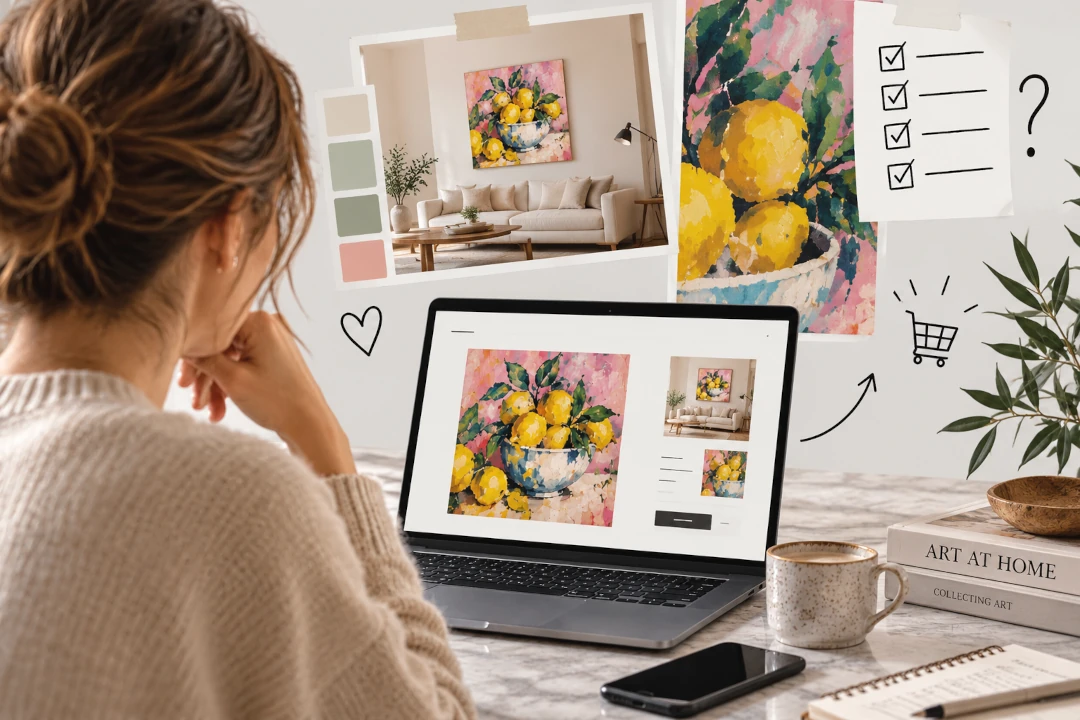
What Makes People Buy Art Online? A Guide for Artists
Selling art online is not only about getting more people to see your work. A potential buyer may already love an artwork and still hesitate before purchasing it.
Why? Because buying art involves emotion, taste, money, space and trust. Online, the buyer cannot stand in front of the artwork, inspect it closely or immediately see how it will look at home. Your presentation therefore has to answer many of those questions for them.
Understanding what makes people buy art online can help you remove unnecessary uncertainty and create a smoother path from discovering your work to feeling confident enough to own it.
1. They Feel an Emotional Connection to the Artwork
Art is rarely purchased for purely practical reasons. People buy work because something about it catches their attention, creates a feeling, reminds them of something or simply makes them want to keep looking.
That emotional response is difficult to manufacture, and you should not try to make your work appeal to everyone. Instead, give the right people enough opportunity to connect with it. Show your strongest work clearly, avoid clutter around the artwork and let your visual identity remain consistent across your website, portfolio and social channels.
2. They Can Imagine the Artwork in Their Own Space
One of the biggest disadvantages of selling art online is that buyers see the artwork outside its future environment. A flat image on a white screen does not tell them how the piece will feel above a sofa, in a bedroom or beside furniture they already own.
This is why contextual presentation can be so effective. A realistic room mockup can immediately communicate scale, proportion and style.
With InsituArtRoom, artists can place their artwork in realistic interiors and create presentation images without having to stage and photograph a physical room. The app includes 9 free interiors, with a wider collection available to Premium users.
For an even more personal experience, augmented reality can allow a potential buyer to visualize artwork on their own wall. Read more in our guide to augmented reality for artists.
3. They Understand the Size
Dimensions such as “80 × 100 cm” are essential, but numbers alone can be surprisingly difficult to visualize. A buyer may imagine a piece as much larger or smaller than it actually is.
Always include accurate dimensions and reinforce them visually. Room mockups, photographs beside familiar objects and AR previews can all help buyers understand the real-world scale of an artwork.
4. The Artwork Looks Professional Online
A beautiful original can lose impact when it is represented by a dark, crooked or low-resolution photograph. The buyer can only judge what you show them.
Use clear, sharp images with accurate color and include additional photographs when they provide useful information about texture, edges, framing or details. Our guide on how to photograph artwork covers the basics.
Professional presentation does not mean making everything look overly polished. It means making the artwork easy to understand.
5. They Trust the Artist
A buyer purchasing directly from an independent artist is also buying from a person or small business they may never have dealt with before.
Trust becomes especially important as the price increases. A professional website, consistent information, a real artist bio, clear contact details and transparent buying terms all help show that there is a credible artist behind the work.
If your website still needs work, see what every artist website should include.
6. They Know Exactly What They Are Buying
Do not make buyers search for basic information. An artwork page should make the important facts easy to find.
- Artwork title
- Artist name
- Medium and materials
- Dimensions
- Year created
- Whether it is an original, print or limited edition
- Whether framing is included
- Price or a clear way to inquire
- Shipping or delivery information
- Availability status
The easier your information is to understand, the fewer unanswered questions stand between interest and purchase.
7. The Price Feels Understandable
Buyers do not necessarily need your entire pricing formula, but the price should feel consistent with what they are seeing: the size, medium, presentation, experience of the artist and positioning of the work.
Consistency matters too. Similar works should not appear randomly priced without an obvious reason.
If you are still developing your pricing structure, read our guide on how to price your artwork.
8. The Artwork Has a Story, Without Being Overexplained
A short artwork description can add context that an image alone cannot provide. It might explain the inspiration, process, subject, materials or idea behind the piece.
The goal is not to tell the viewer exactly what they must feel. Give them enough context to deepen their connection while leaving room for their own interpretation.
See our guide to writing an artwork description for a simple structure you can use.
9. They Feel Confident the Artwork Is Authentic
When someone buys an original or limited edition, documentation can increase confidence and make the purchase feel more complete.
A certificate of authenticity can record key details such as the artist, title, medium, dimensions, year and edition information. Learn what to include in our certificate of authenticity guide.
10. Buying Does Not Feel Complicated
Every unnecessary step creates another opportunity for someone to postpone a purchase.
If the work is available to buy directly, make the next action obvious. If buyers need to contact you, explain exactly how. If you accept commissions, describe the process rather than leaving potential clients to guess.
Artists who offer custom work can also read our guide to art commissions.
11. Shipping Does Not Feel Like a Risk
Buying art online means trusting that a valuable or unique object will arrive safely. Buyers may hesitate if they do not know where you ship, how the artwork will be packaged, how long delivery may take or what happens if there is a problem.
Clear shipping information can remove a surprisingly large amount of uncertainty. You do not need to overwhelm the artwork page with policies, but buyers should be able to find the answers easily.
12. They Have Seen the Artist More Than Once
Not every buyer purchases the first time they discover an artist. Someone may see your work on Instagram, encounter it again through your website, join your email list and return weeks later.
This is why consistent visibility matters. Marketing is not simply about pushing people to buy immediately. It helps potential collectors become familiar with your work over time.
For ideas on building that visibility, see our art marketing guide for artists.
13. They Can Picture Themselves Owning It
This is where several of the factors above come together. The buyer likes the artwork, trusts the artist, understands the size and price, and can imagine the piece becoming part of their home.
Good online art presentation helps bridge the gap between seeing an image and imagining ownership.
Instead of showing only the isolated artwork, consider creating a small set of complementary visuals: a clean artwork image, a detail shot, one or two realistic room mockups and, where appropriate, an AR viewing option.
What Stops People From Buying Art Online?
Sometimes improving sales is less about adding more marketing and more about removing friction. Common reasons for hesitation include:
- Poor or inconsistent artwork photography
- No clear dimensions
- Uncertainty about scale
- No price and no obvious way to ask for it
- Missing shipping information
- An outdated or incomplete website
- Too little information about the artist
- No clear indication that the artwork is available
- A complicated inquiry or checkout process
- Not being able to imagine the artwork in a real room
A Simple Online Art Buyer Checklist
Before publishing an artwork for sale, look at the page from a buyer's perspective and ask:
- Can I clearly see the artwork?
- Do I understand its size?
- Can I imagine it in a real space?
- Do I know what it is made from?
- Do I know whether it is original or an edition?
- Can I find the price?
- Do I understand shipping?
- Do I trust the person selling it?
- Is the next step obvious?
If several answers are “no,” those are useful places to improve before spending more time or money driving traffic to the page.
Final Thoughts
People buy art because they connect with it. But connection alone does not always complete the sale online.
Buyers also need confidence. They need to understand what they are buying, how large it is, what it will look like in a real space, who they are buying from and what happens after they pay.
Your job is not to pressure someone into buying. It is to make sure that when the right person falls in love with your artwork, unnecessary uncertainty does not get in the way.
Help Buyers Picture Your Art in Their Space
Create realistic artwork mockups with InsituArtRoom and give potential buyers more context before they make a decision. Start with 9 free interiors.
Try InsituArtRoom