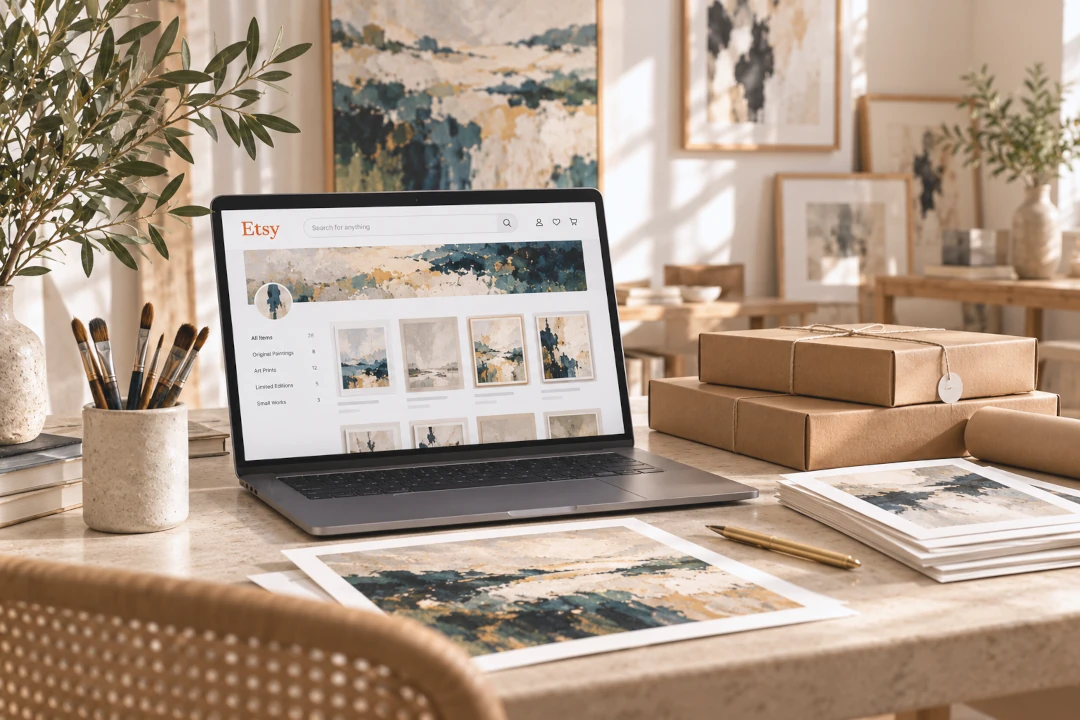
Selling Art on Etsy: A Practical Guide for Artists
Etsy gives independent artists a way to put their work in front of people who are already browsing for creative products. But simply opening a shop and uploading a few photographs is rarely enough to make an artwork stand out.
Successful selling art on Etsy depends on several things working together: the art itself, strong listing images, clear information, appropriate pricing, search-friendly listings and enough visual context for a buyer to imagine owning the piece.
This guide focuses on building stronger Etsy art listings and a more convincing shop, whether you sell original paintings, art prints or both.
Is Etsy a Good Place to Sell Art?
Etsy can be useful for artists because visitors arrive with shopping intent. Unlike a social feed, Etsy users are actively searching and comparing products. Think of Etsy as one possible sales channel rather than your entire art business.
If you are still deciding where to sell, see Where to Sell Art Online.
1. Decide What You Will Sell
Start with a clear offer: original paintings, limited-edition prints, open-edition prints, photography, illustrations or a combination. Originals and prints create different buyer expectations and should be presented accordingly.
For print-specific advice, read How to Sell Art Prints Online.
2. Make Your Etsy Shop Feel Cohesive
A buyer may discover one listing and then visit the rest of your shop. Make that second step worthwhile. Keep enough consistency in presentation, photography and information that the shop feels intentional.
Your artist bio can also help communicate the person behind the work.
3. Treat Your First Listing Image Like a Shop Window
The first image has one immediate job: earn enough attention for someone to open the listing. Keep the artwork easy to see and avoid clutter that competes with it.
Good photography is the foundation. See How to Photograph Artwork.
4. Use Several Images to Answer Buyer Questions
One photograph rarely communicates everything. Useful listing images can include a clean view of the artwork, a realistic room mockup, close-up details, a side view, framed presentation and an image that communicates scale.
5. Create Realistic Etsy Art Mockups
Room mockups help answer a question a flat product photograph cannot: What might this look like in a real space?
With InsituArtRoom, you can place your artwork in curated interiors, adjust its size and position, and test different frames and mats. You can start with 9 free interiors, while Premium opens the wider interior collection.
For a focused walkthrough, see How to Create Art Mockups for Your Etsy Shop.
Create Better Images for Your Etsy Art Listings
Use InsituArtRoom to place your artwork in realistic interiors and create polished listing images without photographing every piece in a different room.
Try InsituArtRoom6. Show Scale Clearly
Dimensions are essential, but numbers alone can be difficult to visualise. A contextual image helps buyers understand whether a piece feels small, medium or statement-sized. Keep the scale believable.
7. Write Etsy Titles for Humans and Search
Your title should make the product understandable quickly while using language potential buyers may search for. Depending on the work, include useful information such as artwork type, subject, style, colour or medium. Keep it natural rather than repeating near-identical keywords.
8. Write Descriptions That Reduce Uncertainty
Combine the story of the piece with practical information such as title, dimensions, medium, materials, whether it is an original or print, framing, edition information, signature and shipping details.
See How to Write an Artwork Description.
9. Use Etsy Search Terms Naturally
Think about phrases a buyer might use when searching for art like yours: subject, style, medium, colour, format or intended space. Specific language is more informative than generic phrases. Use relevant terms naturally and avoid unrelated keywords.
10. Price Your Art Consistently
Pricing should make sense across Etsy and your other sales channels. Account for materials, production, packaging, platform costs, shipping arrangements and the value of your work.
See How to Price Your Artwork.
11. Explain Exactly What the Buyer Receives
Make it obvious whether the buyer receives a physical print, original artwork or digital file. If mockups show a frame or styled room for presentation, clarify whether those items are included.
12. Build Trust With Detail Images
Close-up photographs can show brushwork, paper texture, canvas surface and other physical details. They complement room mockups: one communicates context while the other communicates the object itself.
13. Make Shipping Information Easy to Understand
Be clear about packaging, whether work ships framed or unframed where relevant, and important processing information. Avoid promises you cannot reliably meet.
14. Consider a Certificate of Authenticity
For original artwork or limited editions, a certificate can add useful documentation and reinforce professional presentation. See Certificate of Authenticity for Artwork.
15. Bring Traffic to Etsy From Outside Etsy
Do not rely only on marketplace search. Instagram, Pinterest, your website and mailing list can introduce potential buyers to specific pieces.
For a broader strategy, see Art Marketing for Artists.
16. Turn Listing Images Into Social Content
A room mockup can become an Instagram post, Story, Pinterest image or part of a Reel. InsituArtRoom can also turn artwork displayed in interiors into vertical Reels using effects including Zoom In, Zoom Out and Bird's Eye.
17. Help Buyers Imagine the Artwork in Their Own Room
InsituArtRoom's View in your room feature provides an AR preview that can help a potential buyer consider placement or scale.
Learn more in Augmented Reality for Artists.
18. Refresh Weak Listings
If a listing receives little attention, review the first image, title, description, price, contextual images and overall presentation before assuming the artwork itself is the problem.
19. Learn From the Listings That Get Attention
Look for patterns in views, favourites, enquiries and sales. Use those signals to improve future listings without letting marketplace data dictate what you create.
20. Keep Your Shop Active Without Making It Chaotic
Add new work when it is ready, update availability promptly and improve older listings when needed. Consistency is more useful than constant changes without a clear reason.
A Simple Etsy Art Listing Checklist
- Clear first image.
- Accurate artwork photograph.
- Realistic room mockup.
- Detail image.
- Clear sense of scale.
- Readable title.
- Relevant search terms.
- Complete artwork information.
- Consistent pricing.
- Clear framing and shipping information.
- Obvious distinction between original, print and digital product.
Common Mistakes When Selling Art on Etsy
- Using only one image.
- Making the artwork too small in the first image.
- Using unrealistic room mockups.
- Leaving dimensions buried in a long description.
- Not explaining whether a frame is included.
- Writing titles for algorithms rather than buyers.
- Using vague descriptions.
- Pricing inconsistently.
- Depending entirely on Etsy for traffic.
- Failing to improve older listings.
Give Your Etsy Artwork More Context
InsituArtRoom helps you create realistic interior presentations for your paintings and prints, reuse those visuals across your marketing and give potential buyers a clearer idea of how your work could look on a wall.
Create Your First MockupFinal Thoughts
Selling art on Etsy is not only about being present on the marketplace. Your listings need to communicate quality, context and trust quickly.
Start with strong artwork photography, add realistic mockups and useful details, make titles and descriptions easy to understand, and remove as much uncertainty as possible from the buying process.