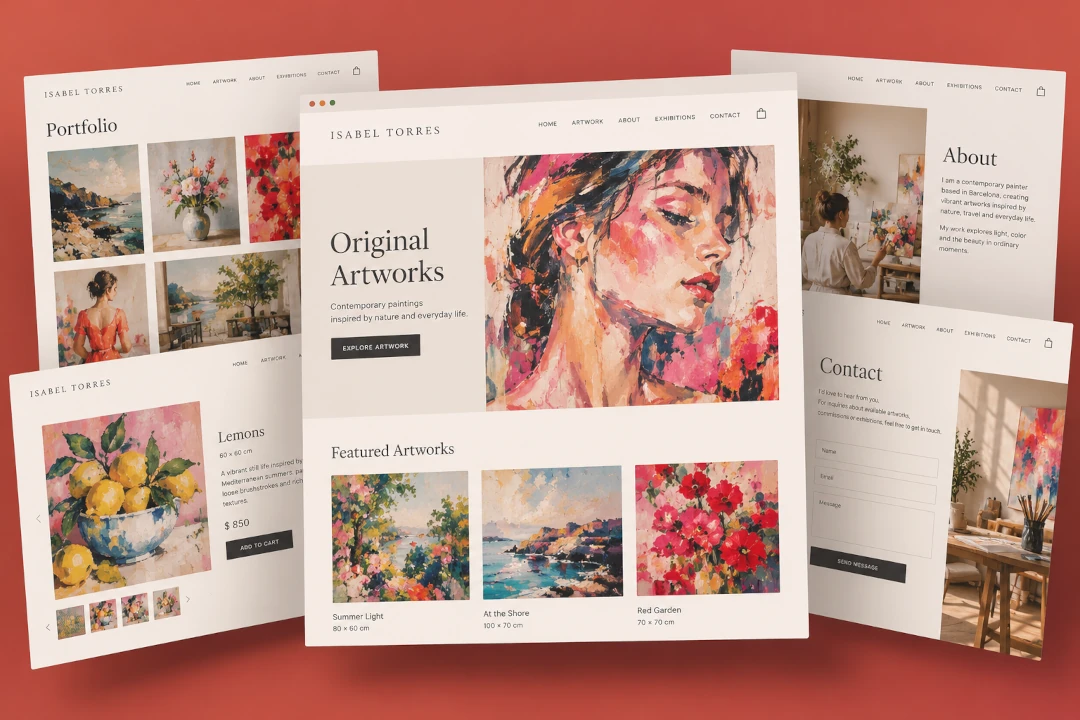
Artist Website: What Every Artist Website Should Include
Social media can help people discover your art, but an artist website gives your work a permanent home that you control. It is where a potential collector, gallery, client or follower can see your strongest work without competing posts, changing algorithms or distractions from other accounts.
A good website for artists does not need to be complicated. It needs to answer a few important questions quickly: Who are you? What kind of art do you create? Where can people see more? Is the work available? And what should someone do if they want to buy, enquire or follow your practice?
Here are the elements that can turn a simple art website into a stronger portfolio, marketing tool and sales destination.
1. A Clear Homepage
Your homepage should immediately make it obvious that visitors have arrived at an artist's website. Avoid making people search for the art. A strong homepage might include one excellent artwork or a small selection of representative pieces, your name, a short description of your practice and clear links to the most important parts of the site.
2. A Focused Art Portfolio
Your portfolio should show your strongest and most relevant work rather than everything you have ever made. If you work in several styles, media or series, organise them into collections or projects that are easy to navigate.
For a more detailed approach, see How to Make an Art Portfolio.
3. High-Quality Artwork Images
Your website may be the first place a buyer sees your work in detail, so image quality matters. Photographs should represent the artwork accurately, with good lighting, straight edges and enough resolution to see the work clearly.
See How to Photograph Artwork for practical tips.
4. Individual Pages for Important Artworks
Giving significant artworks their own pages creates room for more information and can give search engines a clearer understanding of your site. Include the title, large image, dimensions, medium, year, availability, price or enquiry information, description, detail photographs and an interior view where useful.
For help with the text, see How to Write an Artwork Description.
5. Show Artwork in Context
A clean artwork image is essential, but it does not always communicate scale or help someone imagine the piece in a real environment. A realistic room mockup can show how a painting, photograph or print might relate to furniture, wall space and the surrounding interior.
With InsituArtRoom, artists can place their work in curated interiors, adjust the artwork's size and position, and experiment with frames and mats. You can start with 9 free interiors, while Premium gives access to the wider interior collection.
Create Images for Your Artist Website
Show your artwork in realistic interiors without organising a separate room photo shoot for every piece. Create portfolio and artwork-page visuals with InsituArtRoom, starting with 9 free interiors.
Try InsituArtRoom6. Communicate Scale Clearly
Dimensions are precise, but not every visitor can immediately visualise what 80 × 100 cm will look like on a wall. Use written dimensions together with contextual images when appropriate, and keep visualisations realistic.
7. Include an Artist Bio
An artist bio can briefly cover your background, practice, selected experience and relevant achievements. It should support the work rather than overwhelm it.
Read How to Write an Artist Bio.
8. Add an Artist Statement When It Adds Value
A biography explains who you are. An artist statement can explain the ideas, questions, materials or processes behind your practice. Avoid unnecessary jargon when a simpler explanation communicates the idea more effectively.
9. Make Contact Information Easy to Find
Do not make a collector or potential client search through several pages to contact you. If you accept commissions, gallery enquiries or collaborations, say so clearly.
If commissions are part of your practice, see Art Commissions: A Practical Guide for Artists.
10. Make Availability Clear
If your website helps sell art, visitors should understand which pieces are available. You might use labels such as available, sold or reserved, or separate available work into its own section. Keep the information current.
11. Decide Whether to Show Prices
Some artists display prices directly while others invite enquiries. If prices are shown, keep them consistent with your other sales channels. If buyers must enquire, make the process simple.
See How to Price Your Artwork.
12. Give Buyers Enough Information to Feel Confident
Buying art online involves uncertainty. Combine accurate photographs, close-up details, dimensions, clear descriptions and contextual images rather than expecting one photograph to do everything.
13. Add AR When Visualisation Matters
Prepared interior mockups show how artwork can look in a selected environment. InsituArtRoom's View in your room feature can help someone visualise the piece on their own wall when considering scale and placement.
Learn more in Augmented Reality for Artists.
14. Keep Navigation Simple
A straightforward structure might include Home, Work or Portfolio, About, Available Work or Shop, and Contact. Add Exhibitions, Press, Commissions or Journal only when they serve a real purpose.
15. Make the Website Work Well on Mobile
Many visitors will arrive from a social post, message or search result on their phone. Check that artwork remains easy to see, text is readable and buttons are easy to use. Optimise image files so the portfolio remains fast.
16. Use Search-Friendly Page Titles
Use descriptive page titles rather than vague labels. Individual artwork and collection pages should contain enough text to explain what they show, while image alt text should describe the relevant image naturally.
17. Consider a Blog or Journal
A blog can give you space to publish exhibition news, studio updates, collection stories or process articles. It can also create searchable pages beyond your portfolio, provided the content has a genuine purpose.
18. Connect Your Website to Social Media
Social platforms can introduce new people to your work, while your website gives interested visitors somewhere deeper to explore.
See Instagram for Artists and How to Sell Art on Instagram.
19. Use Reels to Bring People Back to Your Website
A Reel can point viewers toward an artwork page, portfolio or available collection. InsituArtRoom can create vertical Reels from artwork displayed in interiors using effects including Zoom In, Zoom Out and Bird's Eye.
See How to Make Art Reels for Instagram.
20. Build an Email List
A website is a natural place to invite interested visitors to stay in touch. An email list can help you announce new collections, exhibitions, available artwork, prints or studio news without depending entirely on a social platform.
21. Make Selling Art Straightforward
If visitors can purchase directly, make the product clear and provide relevant information about payment, shipping and returns. If you sell elsewhere, your website can still act as the central portfolio and direct visitors to the appropriate destination.
Read How to Sell Art Online.
22. Include Trust Signals Where Relevant
Exhibition history, press coverage, selected testimonials or professional affiliations can help visitors understand your experience. Use them selectively so the artwork remains central.
23. Keep the Website Updated
Remove or update old exhibition notices, mark sold work correctly and add significant new pieces or collections. Accurate information and strong current work matter more than constant redesigns.
A Simple Artist Website Structure
- Homepage: strong artwork, brief introduction and clear navigation.
- Portfolio: selected work organised into useful collections.
- Artwork pages: images, dimensions, medium, description, availability and contextual presentation.
- About: artist bio and, where useful, artist statement.
- Available work or shop: a clear path for buyers.
- Contact: an easy way to enquire.
Artist Website Checklist
- Your name and art are easy to find.
- The portfolio contains your strongest work.
- Artwork images are high quality.
- Important pieces have useful information and dimensions.
- Interior mockups are realistic.
- Your bio is current.
- Contact information is easy to find.
- Availability is accurate.
- Prices or enquiry instructions are clear.
- The site works well on mobile.
- Navigation is simple.
- Pages have descriptive titles.
Common Artist Website Mistakes
- Hiding the artwork behind a complicated homepage.
- Uploading every piece instead of curating the portfolio.
- Using poor-quality photographs.
- Providing no dimensions or artwork details.
- Using unrealistic mockups.
- Making contact information difficult to find.
- Leaving sold work marked as available.
- Using huge image files that make the site slow.
- Designing only for desktop screens.
Make Your Artist Website More Visual
InsituArtRoom helps artists create realistic interior mockups, framed presentations and visual content from artwork they already have. Use those images across portfolio pages, artwork listings, social media and sales content, starting with 9 free interiors.
Create Your First MockupFinal Thoughts
The best artist websites do not need to be the most elaborate. They make the artwork easy to discover, give visitors enough information to understand it and provide a clear next step for anyone who wants to learn more or buy.
Start with excellent artwork images and a focused portfolio. Add context through details, descriptions and realistic interior presentation. Then make sure contact, availability and buying information are easy to find.
Your social channels may introduce people to your work, but your website is where you can bring the full picture together on your own terms.