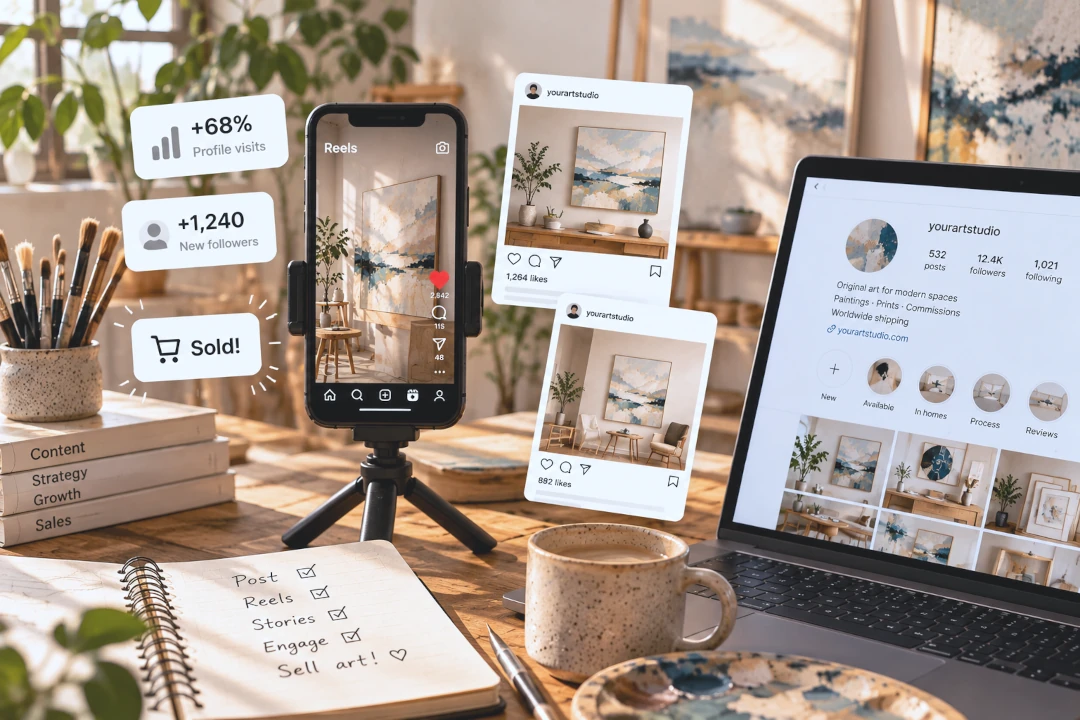
How to Sell Art on Instagram: A Guide for Artists
Instagram can do more for an artist than build an audience. Used strategically, it can help potential buyers discover your work, understand your style, follow your process and eventually take the step from follower to customer.
But selling art on Instagram is not simply a matter of posting a painting and waiting for someone to ask for the price. Your profile, images, captions, presentation and purchasing process all need to make it easy for an interested viewer to move closer to a purchase.
This guide focuses specifically on that journey: how to use Instagram to present artwork, build buyer confidence and create more opportunities to sell your art.
1. Make It Obvious That Your Art Is for Sale
A surprising number of artists post work without making it clear whether it is available. Someone who likes a piece should not have to investigate your entire account to find out if they can buy it.
Use your bio, captions and links to make the next step clear. Depending on how you sell, that might mean directing people to your website, online shop, marketplace profile or contact method.
2. Treat Your Instagram Profile Like a Shop Window
A potential buyer may arrive through a single Reel or post and then open your profile. In a few seconds, they should be able to understand that you are an artist, what kind of work you create and where they can see or buy more.
Use a recognisable profile image, a concise bio and a useful link. Your recent posts should give a reasonably clear impression of your work without requiring every image to look identical.
For a broader guide to building your presence, see Instagram for Artists.
3. Start With Excellent Images of the Artwork
Instagram is visual, so poor photography can weaken even strong artwork. Use sharp images with accurate colour, controlled reflections and enough resolution for viewers to see the piece clearly.
Whenever possible, include a clean front-facing image of the actual artwork. Contextual images are valuable, but buyers should also be able to inspect the work without a room, frame or graphic covering it.
Our guide to photographing artwork explains how to create better source images.
4. Show What the Artwork Looks Like in a Room
One difficulty with buying art online is imagining how an isolated image will look on a real wall. A realistic interior mockup can help bridge that gap.
With InsituArtRoom, you can upload your artwork and place it in realistic interiors, adjust its size and position, and experiment with frames and mats. You can start with 9 free interiors, while Premium provides access to the wider interior collection.
This gives you contextual images that can be used in Instagram posts, carousels, Stories, Reels and sales pages without physically staging every artwork in a different room.
Turn Your Artwork Into Instagram-Ready Content
Create realistic room mockups and Reels with InsituArtRoom, then use them to show potential buyers how your artwork could look beyond the studio. Start with 9 free interiors.
Try InsituArtRoom5. Use Carousels to Answer Buyer Questions
One artwork can provide enough material for a useful Instagram carousel. Instead of uploading several nearly identical images, give each slide a purpose.
You might start with the artwork itself, follow with a close-up detail, show it in an interior, include another view that communicates scale and finish with practical information about the piece.
This lets someone explore the artwork without leaving the post and can make a sales-focused post feel informative rather than repetitive.
6. Use Reels to Reach Beyond Your Existing Followers
Reels give you another way to present artwork and can help people discover your work in a format different from a static post.
You do not need to film elaborate videos for every piece. InsituArtRoom can create vertical Reels from artwork presented in interiors, with effects including Zoom In, Zoom Out and Bird's Eye.
See How to Make Art Reels for Instagram for more ideas.
7. Show Scale Clearly
Dimensions such as 60 × 80 cm are useful, but not everyone immediately visualises what those measurements mean on a wall.
Include dimensions in the caption or sales page, then reinforce them visually with a realistic room presentation. Make sure the artwork is shown at a believable scale rather than enlarging it simply to make the image more dramatic.
8. Write Captions That Help People Understand the Work
A caption does not need to be an essay. Give viewers something useful: what inspired the work, how it was made, what materials you used, whether it belongs to a series or what makes this particular piece important to you.
If the artwork is available, include that information naturally. Avoid making every caption feel like an advertisement.
For longer sales or portfolio copy, see How to Write an Artwork Description.
9. Include the Information a Buyer Actually Needs
When you post artwork for sale, make essential information easy to find. Depending on the work, this can include:
- Artwork title.
- Original or print.
- Medium.
- Dimensions.
- Year.
- Framed or unframed.
- Edition size, if relevant.
- Price or clear instructions for obtaining the price.
- Where or how to buy.
If you are unsure how to set your prices, read How to Price Your Artwork.
10. Give Every Sales Post a Clear Next Step
If someone wants the artwork, what should they do next?
Do not make buyers guess. Tell them whether they should visit the link in your bio, open your website, send an enquiry or use another purchasing route. The fewer unnecessary steps between interest and purchase, the better.
11. Build Trust Before Asking for the Sale
Buying art online often involves more trust than buying an inexpensive everyday product. Potential buyers may want reassurance that the artist is genuine, the work exists and the transaction will be handled professionally.
Show your process occasionally. Share studio images, works in progress, exhibitions, packaging or other authentic parts of your practice. Keep artwork information consistent across Instagram and your sales pages.
A professional artist bio and a focused online portfolio can also give interested buyers somewhere to learn more about you.
12. Show Details That Are Difficult to See in the Main Image
Texture, brushwork, paper surface, edges and framing can disappear in a full artwork image on a small screen.
Use close-ups where they genuinely reveal something about the work. These details can make the artwork feel more tangible and help a buyer understand what they would actually receive.
13. Let Buyers Imagine the Artwork in Their Own Home
A room mockup helps someone understand an artwork in a prepared setting. Augmented reality can go one step further by helping them visualise it in their own environment.
InsituArtRoom's View in your room feature lets viewers preview artwork on a real wall using AR. This can be particularly useful when someone is considering scale, placement or how the piece might work with their interior.
Read more in Augmented Reality for Artists.
14. Do Not Make Every Post a Sales Post
If every caption says “available now”, followers have little reason to stay engaged between purchases. Your Instagram account should also give people reasons to care about the work and follow your development.
Mix sales posts with new work, studio moments, details, process, ideas, finished installations, exhibitions and useful stories about your practice.
Then when you do announce that a piece is available, the audience already has context for it.
15. Reuse One Artwork Without Repeating the Same Post
You do not need a new painting every time you want to post. One artwork can become several distinct pieces of content:
- A clean image of the artwork.
- A close-up detail.
- A room mockup.
- A carousel.
- A Reel.
- A process or studio post.
- A Story about availability.
- An AR preview or demonstration.
The key is that each format should add something rather than simply reposting the same image.
16. Use Highlights for Information Buyers May Need
Stories disappear quickly, but Highlights can keep useful information accessible from your profile. You can organise them around available work, sold work, exhibitions, studio process, commissions, shipping or frequently asked questions.
Keep the categories simple. A buyer should be able to understand them without decoding creative but unclear names.
17. Connect Instagram to a Stronger Sales Destination
Instagram can generate discovery and interest, but it does not have to carry the entire sales process.
Your website, portfolio, shop or marketplace listing can provide larger images, complete artwork information, payment options and other details that are awkward to fit into a social post.
For a wider look at sales channels, see Where to Sell Art Online and How to Sell Art Online.
How to Sell Art Prints on Instagram
The same principles apply to prints, but buyers also need to understand the available sizes, paper or canvas type, whether the print is signed, whether it is an open or limited edition and whether framing is included.
Mockups can be particularly useful when one image is available in several print sizes because they help communicate how different formats might look in a room.
For the complete print-selling process, read How to Sell Art Prints Online.
Should You Put Art Prices on Instagram?
There is no universal rule, but clarity reduces friction. If you are comfortable publishing the price, it allows interested buyers to understand immediately whether the work is within their budget.
If you prefer not to display prices publicly, provide a simple and consistent way to request them. Avoid making the purchasing process feel mysterious or unnecessarily difficult.
Do You Need a Large Following to Sell Art on Instagram?
A large audience can increase reach, but follower count alone does not determine whether an artist can make sales. A smaller audience that genuinely cares about your work may be more valuable than a much larger but disengaged one.
Focus on presenting the work well, reaching the right people and making it easy for interested viewers to take action.
If audience growth is also a priority, see How to Get More Followers as an Artist.
A Simple Instagram Sales Workflow for Artists
- Photograph the artwork clearly.
- Prepare accurate artwork information.
- Create one or more realistic room mockups.
- Create a Reel or additional visual format.
- Publish a post or carousel with useful context.
- State clearly when the artwork is available.
- Give the viewer an obvious route to buy or enquire.
- Reuse the artwork later in a different content format.
Create More Content From Every Artwork
Use InsituArtRoom to create realistic interior mockups, test frames, produce vertical Reels and let potential buyers visualise your artwork on their own walls. Start with 9 free interiors and explore the wider Premium collection when you need more options.
Explore InsituArtRoomCommon Mistakes When Trying to Sell Art on Instagram
- Posting low-quality photographs of the artwork.
- Never making it clear that work is available.
- Giving buyers no obvious way to purchase or enquire.
- Showing artwork at unrealistic scale in mockups.
- Posting only promotional content.
- Leaving out dimensions and other important information.
- Using the same image repeatedly instead of varying the presentation.
- Having an Instagram profile that leads nowhere beyond Instagram.
Final Thoughts
Instagram can help artists sell work because it combines discovery, visual presentation and direct connection with an audience. But the strongest accounts do more than repeatedly ask followers to buy.
Show the artwork clearly, give it context, share enough of your practice to build trust and make the buying process easy to understand. Use clean photographs for accuracy, mockups for scale and context, Reels for another route to discovery and AR when buyers want to imagine the work in their own space.
When those pieces work together, Instagram becomes more than a gallery of posts. It becomes one part of a wider system for turning attention into genuine interest and, ultimately, art sales.