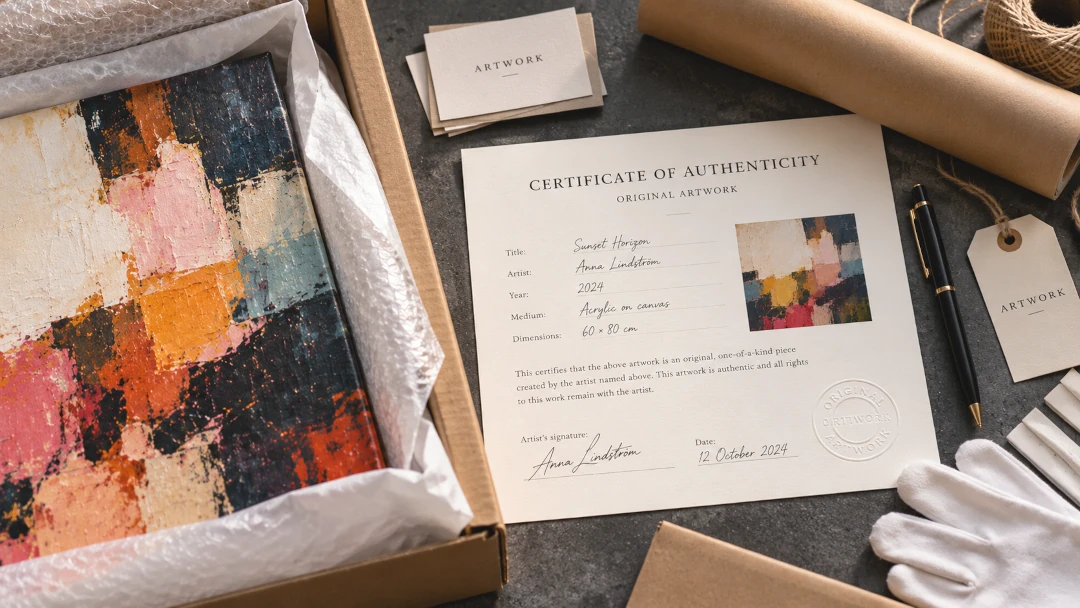
How to Create a Certificate of Authenticity for Artwork
A certificate of authenticity for artwork, often called a COA, is a document that records key information about a work and confirms its connection to the artist or another authorised issuer. For artists selling original work or limited editions, it can become an important part of the documentation that accompanies a sale.
A good certificate does not need to be complicated. It should be clear, accurate, consistent with your other artwork records, and specific enough to identify the piece it belongs to.
In this guide, we explain what an art certificate of authenticity is, what information to include, how certificates work for original artwork and limited editions, common mistakes to avoid, and a simple template you can adapt for your own work.
What Is a Certificate of Authenticity for Artwork?
A certificate of authenticity is a document associated with a particular artwork. It records identifying information about the work and states who created or authenticated it.
For a living artist selling their own work, the certificate is usually issued by the artist. Depending on the circumstances, documentation for other works may instead come from an estate, gallery, publisher, foundation, or another party with appropriate authority.
A COA should be treated as part of the artwork's documentation rather than as a decorative extra. The information on the certificate should agree with the information in your inventory, sales records, portfolio, and any listing used to sell the piece.
Do Artists Need a Certificate of Authenticity?
Not every artwork transaction follows the same process, and requirements can vary by country, type of work, seller, gallery, marketplace, or agreement. A certificate should therefore not be treated as a universal legal requirement.
However, providing clear documentation can be useful when selling original works and limited editions. It gives the buyer a record of what they purchased and gives the artist a consistent way to document the work that left the studio.
For valuable works or situations involving specific legal, tax, provenance, or contractual questions, professional advice may be appropriate.
What Should an Art Certificate of Authenticity Include?
The exact information depends on the artwork, but a useful certificate commonly includes:
- Artist's full name or professional artist name
- Title of the artwork
- Year of creation
- Medium and materials
- Dimensions
- Whether the work is an original or part of an edition
- Edition number and edition size, when applicable
- A unique inventory or artwork reference number, if you use one
- A short statement confirming authenticity
- Date the certificate was issued
- Artist's or authorised issuer's signature
You may also include an image of the artwork, relevant framing information, the location of the artist's signature on the work, or other identifying details when these help connect the certificate to the correct piece.
1. Artist Name
Use the same name that you use professionally on your artwork, website, portfolio, exhibitions, and sales documentation. Consistency makes records easier to follow over time.
If you are still developing the written presentation of your practice, our guide on how to write an artist bio can help you create a clear professional introduction.
2. Artwork Title
Write the complete title exactly as it appears in your inventory and other documentation. Avoid changing punctuation, spelling, or subtitles between your certificate, online listing, and portfolio.
If a work is genuinely untitled, record it consistently rather than inventing a different title for the certificate.
3. Year of Creation
Include the year the artwork was completed. If your normal cataloguing system uses a more specific date and that information is useful, you can record it consistently across your documentation.
4. Medium and Materials
Describe what the artwork is made from in clear terms. Examples might include oil on linen, acrylic on canvas, watercolour on paper, archival pigment print, or mixed media on panel.
Avoid vague descriptions when more precise information is available. Buyers, galleries, framers, conservators, and future owners may all benefit from accurate material information.
5. Dimensions
Record the dimensions accurately and state the unit of measurement. If the framed dimensions are important, distinguish them from the dimensions of the artwork itself.
For three-dimensional work, include the relevant height, width, and depth measurements.
6. Original or Edition
Clearly identify whether the certificate relates to a unique original work or to a work produced as part of an edition.
For an original painting, for example, you might simply identify it as an original artwork. For an editioned print, additional information is needed.
Certificates for Limited Edition Art
If the artwork belongs to a limited edition, the certificate should clearly state the individual edition number and the total edition size.
For example, 7/50 indicates that the work is number 7 in an edition of 50. Keep your numbering consistent with the artwork itself and with your edition records.
You may also need to document artist's proofs or other separately designated impressions if these exist. Edition practices can vary, so describe your own edition accurately rather than using terminology that does not apply to the work.
Should You Include an Image of the Artwork?
Including a small image can make it easier to associate the certificate with the correct artwork, especially when you sell many pieces.
If you include one, use an accurate photograph of the actual artwork rather than a stylised representation. For advice on producing reliable images, see how to photograph artwork.
Use an Artwork Inventory Number
A unique reference number can connect your certificate to your internal records. This becomes increasingly useful as your body of work grows.
Your system can be simple. The important thing is that each identifier is unique and that you use the same identifier consistently in your inventory and related documentation.
Write a Clear Authenticity Statement
The certificate should include a straightforward statement explaining what you are confirming.
For example:
Authenticity statement
I certify that the artwork identified in this document is an authentic work created by me and that the information provided on this certificate is accurate to the best of my knowledge.
Adapt the wording to the circumstances and do not make claims you cannot support.
Sign and Date the Certificate
The artist's signature helps identify who issued the certificate. Add the date of issue as well.
If someone other than the artist is issuing or authenticating the document, the certificate should make that person's or organisation's role clear rather than implying that it was personally issued by the artist.
Simple Certificate of Authenticity Template
You can use the following structure as a starting point for your own certificate:
CERTIFICATE OF AUTHENTICITY
Artist: [Artist name]
Artwork title: [Title]
Year: [Year]
Medium: [Medium and materials]
Dimensions: [Dimensions + unit]
Artwork / inventory number: [Reference number]
For limited editions:
Edition: [Number] of [Total edition size]
I certify that the artwork described above is an authentic work created by me and that the information contained in this certificate is accurate to the best of my knowledge.
Signature: ____________________
Date: ____________________
The design can reflect your visual identity, but clarity is more important than decoration. A buyer should be able to identify the artwork and understand the information without difficulty.
Should a Certificate Include the Price?
In many cases, it is more practical to keep the certificate focused on identifying the artwork rather than using it as a sales receipt. Prices can change over time, while the identifying information about the artwork should remain stable.
Keep invoices, receipts, and sales records separately where appropriate. If you are still deciding how to value your work, see our guide on how to price your artwork.
Certificate of Authenticity vs Receipt
A receipt documents a transaction. A certificate of authenticity documents information about the artwork and its authenticity. They serve different purposes and one should not automatically be treated as a substitute for the other.
For a professional sale, you may therefore have several related records: the artwork listing, invoice or receipt, certificate, shipping information, and your own inventory record.
Certificate of Authenticity vs Provenance
A certificate of authenticity and provenance are also not the same thing. Provenance refers to the documented history of ownership and custody of an artwork.
A certificate issued by the artist can become one piece of the documentation associated with a work, but it does not by itself record every later change of ownership.
Keep Your Own Copy
Do not rely only on the physical certificate that leaves your studio. Keep a digital or physical record of the certificate and the information associated with the artwork.
Your records might include:
- Artwork title and inventory number
- Photograph of the artwork
- Medium and dimensions
- Creation date
- Edition information
- Certificate issue date
- Sale information where appropriate
- Where the work was sent or exhibited
A consistent record-keeping system becomes increasingly valuable as you sell more work.
Make the Certificate Match Your Artwork Records
One of the most important habits is consistency. The title, dimensions, medium, year, edition number, and inventory number on your certificate should agree with the information you use elsewhere.
This includes your portfolio and online artwork descriptions. If you need help presenting individual works clearly, read how to write an artwork description.
When Should You Give the Buyer the Certificate?
For a physical artwork, the certificate can be delivered with the work or according to the process you have agreed with the buyer, gallery, or platform.
If you include a paper certificate in a shipment, protect it from bending, moisture, and damage. Do not place it where packaging materials or the artwork itself can easily mark it.
Should the Certificate Be Attached to the Artwork?
A separate certificate is generally easier to preserve as documentation. Avoid permanently attaching materials to an artwork unless they are appropriate for the work and you understand the conservation implications.
You can still place identifying information on the reverse of an artwork when appropriate to your practice, but the certificate can remain a separate document.
Common Certificate of Authenticity Mistakes
- Leaving out the artwork title or dimensions
- Using information that does not match your inventory
- Failing to identify a limited edition clearly
- Using the same inventory number for different works
- Forgetting to sign or date the certificate
- Making unsupported claims about materials, edition size, or provenance
- Creating a beautiful certificate that does not clearly identify the artwork
- Failing to keep your own record of the certificate
Present the Artwork Professionally Before the Sale
A certificate is one part of a professional presentation. Before someone buys a work online, they also need to understand what the artwork looks like, its size, materials, context, and how it might appear in a real space.
High-quality photographs and realistic room presentations can help buyers evaluate a piece before making a decision.
Present Your Artwork With InsituArtRoom
InsituArtRoom helps artists create professional artwork presentations using realistic interiors, framing options, social content, and augmented reality. Show potential buyers how your work could look in a space before they purchase it.
Present Your Art With InsituArtRoomUse the Same Information When Selling Online
Your online listing should be consistent with your certificate. Use the same title, medium, dimensions, year, and edition information so buyers are not presented with conflicting details.
If you are preparing to sell your work online, see our complete guide on how to sell art online.
Build a Professional Artwork Portfolio
Good documentation also supports your portfolio. Keeping titles, dates, materials, dimensions, and photographs organised makes it easier to update your website, prepare exhibition submissions, communicate with galleries, and create accurate sales listings.
Our guide on how to make an art portfolio explains how to organise and present your work clearly.
Certificate of Authenticity Checklist
Before giving a certificate to a buyer, check that:
- The artist name is correct
- The artwork title matches your records
- The year is correct
- The medium and materials are accurately described
- The dimensions and units are included
- Original or edition status is clear
- The edition number is correct, when applicable
- The inventory number matches your records
- The authenticity statement is accurate
- The certificate is signed and dated
- You have retained your own record
Final Thoughts
A certificate of authenticity for artwork should make the identity of a work clearer, not more complicated. Keep the design professional, but focus first on accurate information and consistent records.
For artists selling their own work, a simple system can go a long way: assign each artwork a unique reference, keep reliable photographs and details, use the same information across your portfolio and sales listings, and create a certificate that clearly corresponds to the piece.
Combined with strong artwork photography, thoughtful descriptions, realistic presentations, and organised records, a certificate can form part of a more professional experience for both the artist and the buyer.
Help Buyers Visualise Your Art
Create realistic room presentations and promotional visuals with InsituArtRoom, then use accurate artwork information and documentation to support the sale.
Try InsituArtRoom