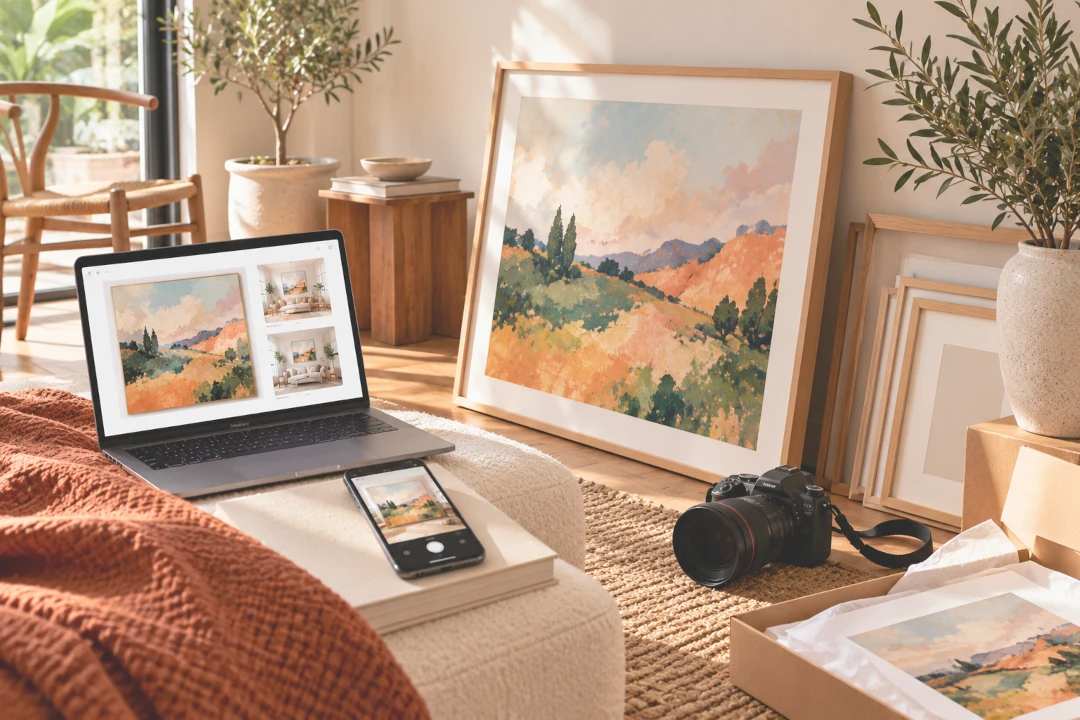
How to Make Your Art Look Professional Online
Your artwork can be excellent and still lose impact online if the presentation does not do it justice. Poor lighting, distracting backgrounds, inconsistent images or unclear scale can make it harder for viewers to understand the work and imagine owning it.
Learning how to make your art look professional online is not about making the artwork appear to be something it is not. It is about presenting it clearly, consistently and in a way that gives potential buyers useful information.
Here are practical ways to improve your online art presentation, whether you are building a portfolio, posting on social media or preparing artwork for sale.
1. Start With a Strong Photograph of the Artwork
Before creating mockups, Reels or sales listings, you need a clean digital image of the artwork itself.
Photograph the piece straight on, use even lighting and avoid glare, strong shadows and distracting surroundings. The edges should look straight rather than distorted by the camera angle, and the colours should resemble the original as closely as possible.
If you work with physical art, our guide to how to photograph artwork explains the process in more detail.
2. Crop and Prepare Your Image Carefully
Remove unnecessary background around the artwork when you need a clean image for a portfolio, listing or mockup. Check that the artwork has not been stretched, compressed or accidentally cropped.
Keep a high-quality master file and create separate versions for different uses rather than repeatedly editing the same file.
3. Keep Your Presentation Consistent
Consistency can make an online portfolio or shop feel much more professional. This does not mean every image has to look identical.
Instead, keep basic decisions consistent: image quality, spacing, naming, information, overall tone and the way you show dimensions or framing.
When a viewer moves from one artwork to another, the presentation should feel like it belongs to the same artist.
4. Show the Artwork on Its Own
A contextual image is useful, but buyers should also be able to see the artwork clearly without furniture, frames or decorative surroundings competing for attention.
Use a clean image as one of the main visuals, especially on product pages and portfolios. Then add contextual images to answer questions about scale, framing and placement.
5. Create Realistic Art Mockups
A room mockup can transform the way an artwork is understood online. Instead of seeing an isolated rectangle on a screen, the viewer can see how the piece might interact with furniture, wall colour and the proportions of a real space.
With InsituArtRoom, you can upload your artwork, place it in realistic interiors, adjust its size and position, and experiment with frames and mats.
There are 9 free interiors to start with, while Premium gives you access to the wider interior collection.
The result can be used for portfolios, online listings, social media, presentations and marketing material.
Give Your Artwork a Professional Setting
Upload your artwork to InsituArtRoom and create realistic interior mockups in minutes. Start with 9 free interiors and explore the wider Premium collection when you need more options.
Try InsituArtRoom6. Make Sure the Scale Looks Real
One of the fastest ways to make a mockup look unprofessional is unrealistic scale. An artwork that appears enormous above a small sofa may attract attention, but it does not give the viewer an accurate idea of the piece.
Use the real dimensions of the artwork as your reference and choose interiors where its proportions make sense.
Realistic scale is especially important when you are selling artwork online because the mockup should help the buyer understand the work, not mislead them.
7. Pay Attention to Perspective
Artwork placed on a wall should follow the perspective of the room. This becomes particularly noticeable when the wall is photographed from an angle.
If the artwork looks completely flat while the rest of the room recedes into perspective, the mockup can immediately feel artificial.
For more on this, see how to create a realistic art mockup with perspective and scale.
8. Use Frames Strategically
A frame can change how an artwork feels. It can make a piece look more finished, demonstrate one possible presentation and help buyers imagine it in their own home.
But the frame should support the artwork rather than dominate it. Try different options and choose the one that suits the piece and the environment.
If the artwork is sold unframed, make that clear in the listing even if some of your presentation images show it framed.
9. Choose Interiors That Fit the Artwork
The room should complement the artwork without overpowering it. A highly decorative interior may work for some pieces, while a simpler wall may be more effective for others.
Think about your likely buyer and where the artwork might realistically be displayed. A living room, office, dining area or bedroom can each communicate something different.
You can explore specific presentation ideas in our living room, office and dining room wall art mockup guides.
10. Do Not Use the Same Mockup for Everything
Using exactly the same room for every artwork can make a portfolio feel repetitive. It can also prevent you from showing how different works suit different environments.
Create some visual variety while keeping the overall presentation coherent. Change the interior, framing or composition when it helps the artwork, rather than changing things simply for the sake of novelty.
11. Write Professional Artwork Descriptions
Professional presentation is not only visual. Buyers also need to understand what they are looking at.
Include the title, medium, dimensions, year and other relevant information. Then add a concise description that helps the viewer understand the work, process or idea behind it.
If writing descriptions is difficult, see our guide to how to write an artwork description.
12. Make Your Artist Bio Easy to Find
A buyer, curator or gallery may discover one artwork first and then want to know more about the person behind it.
A concise artist bio gives context to your practice and helps your website or portfolio feel complete. Keep it relevant and update it as your work develops.
Our artist bio guide includes practical tips and examples.
13. Build a Focused Online Portfolio
A professional portfolio does not need to contain everything you have ever made. A smaller selection of strong, well-presented work can often communicate your practice more clearly.
Use consistent images, organise related work logically and make essential information easy to find.
Read How to Make an Art Portfolio for a complete guide.
14. Turn Static Artwork Into Reels
A professional online presence does not have to rely only on still images. Short-form video can give your artwork another way to attract attention on social media.
InsituArtRoom can create vertical Reels from artwork presented in interiors, with effects such as Zoom In, Zoom Out and Bird's Eye.
This allows you to turn one artwork into several pieces of visual content without filming a new physical setup each time.
See our guide to making art Reels for Instagram for more ideas.
15. Let Buyers Preview Artwork in Their Own Space
A realistic room mockup gives context. Augmented reality adds another layer by helping viewers visualise the artwork on their own wall.
With InsituArtRoom's View in your room feature, viewers can use AR to preview artwork in a real space. This can be particularly useful when someone is considering size, placement or how a piece works with their interior.
Learn more in Augmented Reality for Artists.
16. Keep Social Media Images Focused on the Art
Templates, graphics and text can be useful, but the artwork should remain the focus of an artist's social media presence.
Mix clean artwork images with details, studio photographs, room mockups and Reels. This creates variety without making the feed feel disconnected from the work itself.
For more ideas, see Instagram for Artists.
17. Use the Same Core Information Everywhere
If an artwork is listed on your website, portfolio and marketplace, make sure basic details remain consistent. Titles, dimensions, medium, edition information and availability should not contradict one another.
Keeping accurate records also makes it easier to update listings when a piece is sold or when you create prints or editions.
18. Make It Easy for Someone to Buy or Contact You
A beautiful portfolio can still lose potential buyers if the next step is unclear.
If a work is for sale, make that information easy to understand. If buyers need to contact you, provide a clear route. If you sell through a marketplace or shop, link directly to the relevant artwork rather than making people search for it again.
For a broader sales strategy, read How to Sell Art Online.
Common Mistakes That Make Art Look Less Professional Online
- Dark, blurry or uneven photographs.
- Visible glare on the artwork.
- Distorted proportions or crooked images.
- Mockups with unrealistic scale or perspective.
- Too many decorative elements competing with the artwork.
- Using the exact same room mockup for every piece.
- Inconsistent titles, dimensions or artwork information.
- Overloading social media images with text and graphics.
- Showing only contextual mockups and no clean image of the actual artwork.
- Making it difficult for an interested viewer to take the next step.
A Simple Professional Art Presentation Workflow
- Photograph or digitise the artwork carefully.
- Prepare a clean master image.
- Record the title, medium, dimensions, year and price.
- Create a clean artwork image for your portfolio or listing.
- Create realistic room mockups with InsituArtRoom.
- Test framing and presentation options.
- Create social media images and Reels.
- Add a clear artwork description.
- Publish the work consistently across your channels.
- Give interested buyers an obvious next step.
Professional Does Not Mean Impersonal
A polished online presence should still feel like your work. Professional presentation is not about copying the visual identity of a gallery or another artist.
Your photography, mockups, portfolio and social media should support the personality of the artwork rather than hide it. Consistency creates trust, while individuality makes the work memorable.
Final Thoughts
Making your art look professional online starts with accurate images and clear information. From there, realistic mockups, thoughtful framing, a focused portfolio, Reels and AR can give viewers more ways to experience the work.
The goal is simple: remove distractions and uncertainty so the artwork can make the strongest possible impression.
Present Your Artwork Beyond a Flat Image
Create realistic room mockups, experiment with frames, make Reels and let viewers visualise your artwork on their own wall with InsituArtRoom. Start with 9 free interiors.
Explore InsituArtRoom