How to Promote Artwork Online: 10 Strategies for Artists
Creating great art is only part of building a successful career as an artist. People also need to discover your work. Learning how to promote artwork effectively can help you reach new audiences, attract potential buyers, build relationships with collectors, and create more opportunities for your art.
The good news is that promoting art online no longer requires a huge advertising budget. Artists now have websites, social media, search engines, email, online marketplaces, and visual presentation tools that can help them reach people around the world.
Here are 10 practical strategies you can use to promote your artwork online.
1. Build a Professional Online Presence
Your online presence is often the first impression a potential buyer, collector, gallery, or collaborator will have of you.
At minimum, people should be able to find clear information about who you are, what kind of artwork you create, and where they can see or purchase your work.
A strong online presence can include:
- A professional artist website or portfolio
- High-quality images of your artwork
- A short artist biography
- Information about exhibitions or previous work
- Links to available artwork or your online shop
- Clear contact information
- Active social media profiles
Keep your visual identity reasonably consistent across these channels so that someone who discovers you on social media can immediately recognize your work when visiting your website.
2. Use Social Media to Show More Than Finished Art
Social media can be one of the most accessible ways to promote art online, but simply uploading finished artworks repeatedly can make it difficult to keep people interested.
Give your audience different ways to experience your work.
- Share finished artwork
- Show details and close-ups
- Document your creative process
- Share your studio or workspace
- Show sketches and works in progress
- Explain the inspiration behind a piece
- Show artwork framed or displayed in interiors
- Create short videos and Reels
This turns your social presence into more than a catalog. It allows people to follow the story behind the artwork and get to know you as an artist.
3. Present Your Artwork in Context
How you present artwork can have a major impact on how people perceive it online.
A clean photograph of the artwork is essential, but it does not always communicate its physical scale or how it might feel inside a real space.
Showing artwork in realistic interiors gives viewers another perspective. A potential buyer can see how a painting might look above a sofa, in a bedroom, beside a dining table, in an office, or on a gallery-style wall.
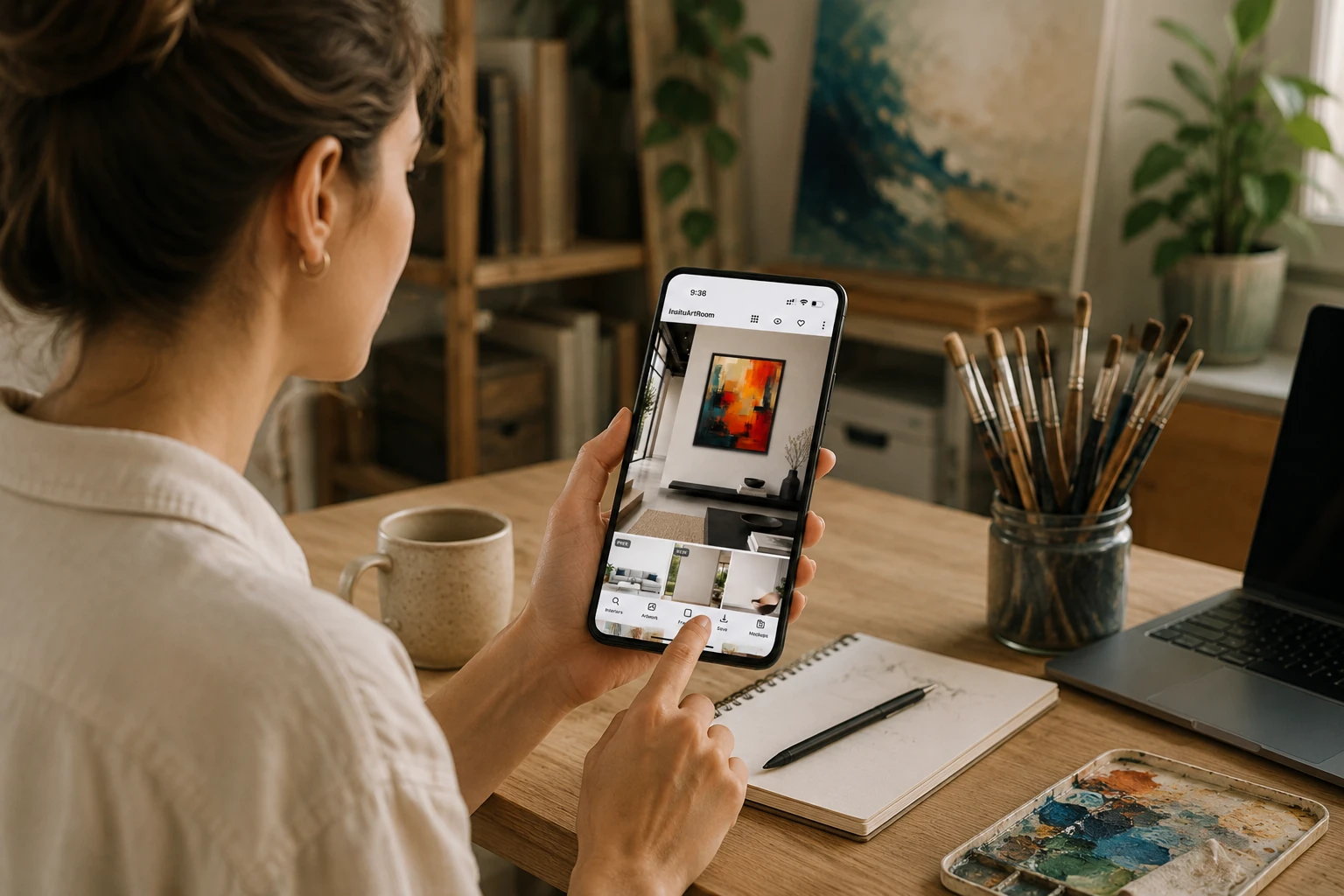
InsituArtRoom lets artists visualize artwork in curated interiors using accurate dimensions, custom frames and mats, lighting and shadows. These images can then be used for social media, portfolios, online shops, websites, and client presentations.
Instead of simply showing people the artwork, you can help them imagine living with it.
4. Create Content People Want to Share
Promotion becomes much more powerful when other people begin sharing your work.
Think about what makes someone stop, save, comment on, or send an art post to another person.
This could be a dramatic before-and-after presentation, an interesting part of your process, a close-up revealing unexpected texture, a new collection, or the same artwork shown in several different interiors.
Strong visual content can introduce your artwork to people who have never encountered your work before.
5. Make Your Artist Website Search-Friendly
Social media is useful for discovery, but search engines can bring people to your work for months or even years after a page is published.
Give individual artwork and collection pages descriptive titles and useful information rather than relying only on images.
For example, include relevant information such as:
- Artwork title
- Type of artwork
- Medium
- Style or subject when relevant
- Dimensions
- A meaningful description of the work
- Descriptive image alt text
Search engine optimization takes time, but it can create a source of traffic that does not disappear as soon as you stop posting.
6. Build an Email List
Social media audiences are valuable, but you do not control the platforms or their algorithms. An email list gives you a direct way to communicate with people who have chosen to hear from you.
You can use email to announce:
- New artwork
- New collections
- Exhibitions and events
- Print releases
- Studio updates
- Limited editions
- Available original pieces
You do not need to email constantly. A smaller list of people genuinely interested in your art can be more valuable than a large audience that rarely engages.
7. Collaborate With Other Artists and Creative Accounts
Collaboration can introduce your work to an audience that already cares about art and creativity.
Collaborations might involve another artist, an interior designer, a gallery, a creative business, an art account, or someone whose audience overlaps naturally with yours.
The goal is not simply to reach the largest possible audience. A smaller but highly relevant audience can often be much more valuable.
8. Make It Easy for Interested People to Buy
Promotion has limited value if someone discovers an artwork they love but cannot figure out whether it is available or how to purchase it.
Wherever possible, make the next step obvious.
- Link social profiles to your website or shop
- Clearly mark available artwork
- Provide dimensions and pricing when appropriate
- Explain shipping and delivery
- Make contact information easy to find
- Keep purchasing steps simple
If selling is one of your goals, our guide on how to sell art online covers the process in more detail.
9. Reuse Your Best Art Content
Artists do not need to create completely new content every day.
One artwork can generate many different pieces of promotional content: a full artwork image, detail photograph, studio shot, process video, framed version, interior mockup, story about its inspiration, or a comparison between different room settings.
You can also adapt the same content for different channels rather than assuming every image or video should only be used once.
This makes consistent promotion much easier, especially when you would rather spend most of your time actually creating art.
10. Be Consistent
One of the most important parts of artist promotion is also one of the simplest: keep showing up.
Building recognition usually takes time. Someone may see your work several times before following you, visiting your website, joining your email list, or considering a purchase.
Consistency does not mean posting constantly. Choose a rhythm that you can realistically maintain and focus on presenting your work well.
How to Promote Artwork Without Spending Money
Many of the most useful art promotion strategies can be started without paying for advertising.
Artists can build an audience through social media, search-friendly website content, collaborations, email, artist communities, and consistent sharing of their creative process.
The trade-off is time. Organic promotion generally takes longer than paid advertising, but the audience and content you build can continue providing value over time.
Should Artists Pay to Promote Their Art?
Paid promotion can be useful, but it works best when your basic online presence is already strong.
Before paying for ads, make sure your artwork is presented professionally, your website or shop is easy to understand, and visitors have a clear next step.
Otherwise, advertising may bring more people to your page without giving them enough reason to stay, follow, contact you, or buy.
Where Should You Promote Your Artwork?
You do not need to be active everywhere. Choose platforms based on where your audience is and what kind of content you can realistically create.
Your own website can act as your central home online, while social platforms can help with discovery and engagement. Email can maintain relationships with interested followers and collectors, while marketplaces can connect artwork with people actively looking to buy.
These channels can work together rather than competing with one another.
Final Thoughts
Learning how to promote artwork is ultimately about making it easier for the right people to discover, understand, remember, and connect with your work.
Build a professional online presence, share more than finished pieces, make your artwork easy to discover and buy, and pay attention to how you present it visually.
You do not need to use every marketing strategy at once. Start with a few channels you can maintain consistently, learn what connects with your audience, and build from there.
Show Your Artwork at Its Best
Create realistic art mockups and show your work in beautiful interiors with accurate dimensions, custom frames, mats, lighting, and shadows. InsituArtRoom makes it easy to create professional images for your website, portfolio, online shop, and social media.
Discover InsituArtRoom