Art Mockups for Artists: How to Present Your Artwork Professionally
Creating the artwork is only one part of presenting yourself professionally as an artist. Online, people also need to understand how your work looks, how large it is, and how it might feel when displayed in a real space. This is where art mockups for artists can be extremely useful.
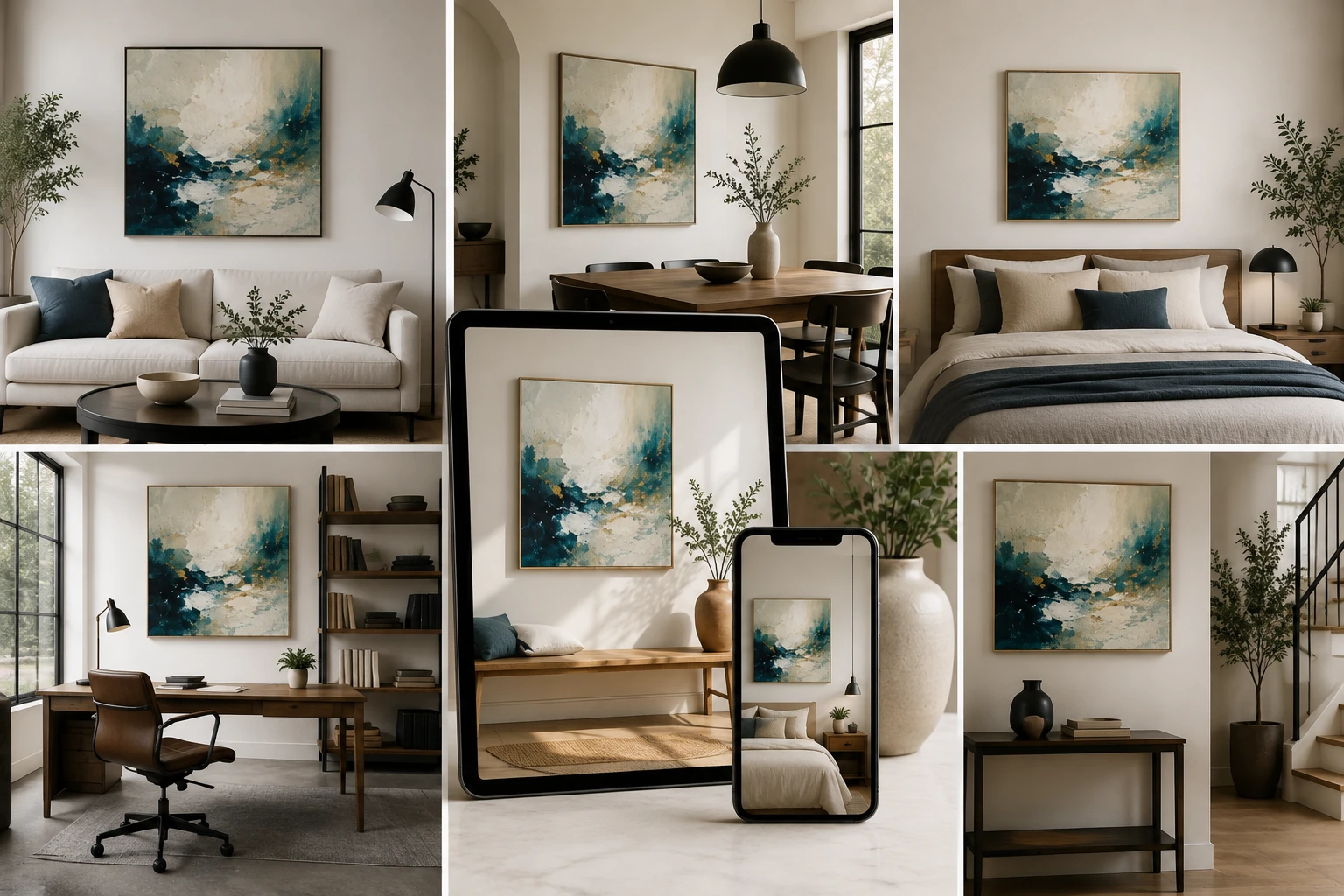
An art mockup places an image of your artwork into a realistic setting, such as a living room, bedroom, gallery wall, office, or other interior. Instead of seeing the artwork only against a plain background, viewers can experience it in context.
Artists can use these images across websites, portfolios, online shops, social media, presentations, and marketing campaigns.
What Is an Art Mockup?
An art mockup is a visual representation of how an artwork could look when displayed in a real environment.
For example, a painting photographed or scanned on its own can be digitally placed above a sofa, on a gallery wall, in a bedroom, or inside a contemporary office.
A good mockup should make the artwork feel naturally integrated into the room rather than simply pasted onto a wall.
Scale, perspective, framing, lighting, shadows, and the relationship between the artwork and surrounding furniture all contribute to making the presentation believable.
Why Should Artists Use Art Mockups?
Art is highly visual, but selling and promoting it online removes much of the physical context a viewer would have in a gallery.
A mockup helps restore some of that context.
It can help viewers understand:
- How large the artwork is
- How it might look when framed
- How it works with furniture and interior design
- How much visual impact it has in a room
- How different framing choices affect the presentation
This makes art mockups useful for both artistic presentation and marketing.
1. Show the Scale of Your Artwork
One of the biggest challenges when viewing art online is understanding size.
Dimensions such as 120 × 90 cm provide accurate information, but numbers alone do not always communicate how substantial a painting will feel on a wall.
Showing that artwork above a sofa or beside recognizable furniture gives the viewer an immediate visual reference.
For artists selling original artwork online, this can be especially valuable because buyers often need to decide whether a piece will work in a particular space.
2. Help Potential Buyers Imagine Owning the Artwork
There is an important psychological difference between seeing a painting and imagining that painting inside your own home.
Contextual presentation helps bridge that gap.
A potential collector viewing artwork in a beautifully styled interior can begin to imagine where the piece might live, what kind of furniture it complements, and how it could change the feeling of a room.
If attracting collectors is one of your priorities, our guide on how to get more art buyers explores additional ways to improve that journey.
3. Create Better Social Media Content
Mockups also give artists more ways to share the same artwork.
Instead of repeatedly uploading the identical photograph, you can show one piece in several environments.
For example:
- The original artwork alone
- The artwork in a minimalist living room
- The same piece in a colorful interior
- A framed version
- A close-up of the artwork
- Several frame or mat combinations
One artwork can therefore generate multiple pieces of visual content without requiring another finished painting.
This can be particularly useful if you are working on growing your audience. See our guide on how to get more followers as an artist for more content strategies.
4. Improve Your Online Art Shop
Product images are one of the most important parts of an online artwork listing.
Your primary image should normally show the artwork clearly and accurately. Additional images can then provide more context.
A useful listing might include:
- A clear front-facing image of the artwork
- Close-ups showing texture and detail
- A photograph of the edges or frame
- An art mockup showing the piece in an interior
- Another mockup showing a different room or scale reference
Together, these images give online buyers a much better understanding of what they are considering.
If you are still deciding where to list your work, see our guide on where to sell art online.
5. Create a More Professional Artist Portfolio
Artist portfolios usually need clear images of the artwork itself, but contextual images can add another dimension to presentations intended for clients, designers, galleries, or collectors.
They can be particularly useful when showing how a collection could work within residential, commercial, hospitality, or gallery environments.
You can learn more in our guide to creating an artwork portfolio mockup.
6. Experiment With Frames Before Choosing One
Framing can significantly change the character of an artwork.
A thin black frame might create a contemporary presentation, while natural wood can introduce warmth. White frames can feel light and minimal, while a mat or passepartout can change the amount of visual space around the artwork.
Digital mockups allow artists to compare these possibilities before making physical framing decisions.
7. Show Artwork in Different Interior Styles
The same artwork can feel surprisingly different depending on its surroundings.
A bold abstract painting might work in a minimalist white interior, an industrial loft, a warm natural living room, or an elegant contemporary space.
Showing those different possibilities can broaden the way potential buyers perceive the artwork without changing the artwork itself.
What Makes an Art Mockup Look Realistic?
The most important characteristic of a good art mockup is that the artwork feels like it belongs in the space.
Several details matter:
- Correct proportions
- Realistic artwork dimensions
- Appropriate perspective
- Natural shadows
- Lighting that fits the room
- Frames that match the artwork
- A suitable position on the wall
If the artwork is obviously too large, too small, incorrectly positioned, or missing realistic interaction with the room, the mockup can look artificial.
How to Create Art Mockups Without Photoshop
Photoshop can be used to create highly customized artwork mockups, but many artists do not need or want to build each presentation manually.
A dedicated wall art mockup generator can make the process much faster.
With InsituArtRoom, you can upload your artwork, choose from a large collection of interiors, adjust the artwork to its actual dimensions, experiment with frames and mats, customize presentation details, and save the finished mockup.
This allows artists to create professional presentations without photographing every artwork inside multiple physical interiors.
Where Can Artists Use Art Mockups?
Once created, a good artwork mockup can be useful in many parts of an artist's business.
- Instagram posts and Reels
- Artist websites
- Online shops
- Art marketplace listings
- Portfolios
- Email newsletters
- Client presentations
- Advertising
- Collection launches
Because one artwork can be presented in many environments, mockups also make it easier to create a consistent flow of promotional content.
Should You Use Mockups Instead of Real Artwork Photos?
No. They serve different purposes.
A buyer should still be able to see an accurate photograph or high-quality image of the actual artwork. Mockups should complement those images rather than replace them.
Think of the original artwork image as showing what the artwork is, while the mockup helps show what the artwork could look like in a space.
Used together, they provide a much more complete presentation.
Are Art Mockups Useful for Selling Art?
They can be.
A mockup cannot make someone love an artwork they do not connect with, but it can remove some of the uncertainty involved in buying art online.
It can help a buyer understand scale, compare framing options, and imagine how the artwork could look after it arrives.
For a broader overview of online selling, read our guide to selling art online.
Art Mockups for Original Paintings vs Prints
Mockups are useful for both original artwork and prints, but they can serve slightly different purposes.
For an original painting, the mockup can communicate the physical presence and scale of a unique piece.
For prints, artists may use mockups to demonstrate different available sizes, frame combinations, orientations, and interior styles.
In both cases, make sure the presentation accurately reflects what the customer will receive.
Final Thoughts
Art mockups for artists are more than decorative marketing images. Used well, they help communicate scale, improve presentation, create more varied content, and make it easier for viewers to imagine artwork outside the studio.
Combine strong images of the actual artwork with realistic contextual presentations and you give potential buyers, followers, and clients a much richer way to experience your work online.
And because one artwork can be placed into many different environments, mockups can become one of the most versatile visual tools in an artist's online presence.
Create Art Mockups in Seconds
Upload your artwork and visualize it in beautiful interiors with accurate dimensions, frames, mats, lighting, shadows, and presentation options. Create professional images for social media, your portfolio, website, online shop, and art marketing.
Create Your Art Mockup with InsituArtRoom