Art Presentation Ideas: 15 Creative Ways to Display Your Art
Great artwork deserves a presentation that supports it. Whether you are preparing a portfolio, posting on social media, approaching a gallery or selling art online, the way you display your work influences how easily people can understand it.
These art presentation ideas go beyond simply placing an image on a white page. They show different ways to communicate scale, texture, context and personality while keeping the artwork itself at the centre of attention.
1. Present the Artwork on a Clean Background
Start with the simplest presentation: a clear, accurate image of the artwork with minimal distraction. This gives viewers an unobstructed look at the piece and works well for portfolios, online shops and artwork listings.
If you are photographing the original yourself, keep the camera parallel to the artwork and use even lighting. Our guide to photographing artwork explains the process in more detail.
2. Add Close-Up Detail Images
Some qualities are difficult to communicate in a full artwork photograph. Add close-ups to reveal brushstrokes, texture, paper, stitching, layered paint or other details that matter to the piece.
This is especially useful when presenting original artwork online because the viewer cannot inspect the surface in person.
3. Place Your Artwork in a Realistic Room
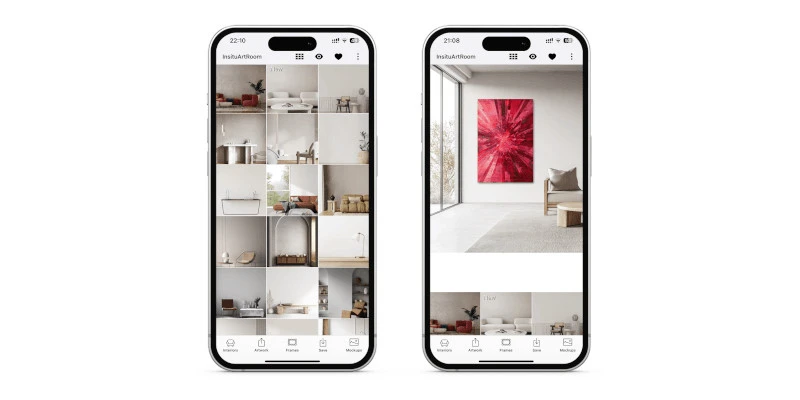
Showing artwork in an interior helps viewers understand how it might look once displayed. A realistic room presentation can communicate approximate scale and create useful visual context for a painting, print or photograph.
With InsituArtRoom, artists can upload artwork and place it in curated interiors without manually building a room scene. There are 9 free interiors to get started, with the larger collection available through Premium.
Explore more ideas in our guide to art mockups for artists.
4. Experiment With Different Wall Colours
The same artwork can feel very different against white, charcoal, green or a warmer neutral wall. Testing several backgrounds can help you discover which environment gives the piece enough contrast without competing with it.
This also gives you more varied presentation material for portfolios and social media.
5. Test Different Frames
Framing changes the visual relationship between the artwork and its surroundings. Depending on the piece, you might compare a minimal frame, a floating presentation or a frame with a mat.
Keep the framing appropriate to the artwork rather than choosing a frame simply because it is decorative. InsituArtRoom includes different framing options so you can preview combinations digitally before using them in your presentation.
6. Create a Gallery-Style Presentation
A spacious gallery environment can give artwork a different character from a residential interior. It works particularly well when you want the presentation to feel exhibition-focused or when preparing visuals for a portfolio or proposal.
Keep the surrounding space restrained so the artwork remains the focal point.
7. Show the Artwork Above Furniture for Scale
Furniture provides familiar visual references. Showing a painting above a sofa, console or desk can help a viewer understand whether the work is small, medium or statement-sized.
Always keep the proportions believable. A mockup should clarify scale, not make the artwork appear larger than it really is.
Try Different Art Presentations in Minutes
Upload your artwork to InsituArtRoom and explore different interiors, wall colours, frames and presentation styles without arranging a new photo shoot for every image.
Create Your Art Presentation8. Build a Consistent Portfolio Series
When several works belong to the same collection, presentation can help them feel connected. Use a consistent image quality, spacing and layout while still allowing each artwork to retain its own identity.
Your portfolio should be selective rather than exhaustive. For a complete structure, read how to make an art portfolio.
9. Combine Artwork Images With Short Context
A visual presentation becomes more useful when viewers can quickly find essential information. Pair the image with the title, dimensions, medium and a concise description where appropriate.
Avoid covering the artwork itself with large amounts of text. Let the image attract attention and place supporting information nearby.
If writing about your work is difficult, see our guide to writing an artwork description.
10. Create a Carousel With Different Views
Instead of trying to communicate everything in one image, use a sequence. A useful carousel might begin with the full artwork, followed by a detail, a room presentation and a final slide with relevant information.
This format works particularly well on social platforms because each image has one clear purpose.
11. Turn Your Artwork Presentation Into a Reel
Motion can make a static artwork presentation more engaging without requiring a complicated video shoot. A subtle zoom or movement through a room scene can give viewers another way to experience the piece.
InsituArtRoom can create vertical art videos with effects including Zoom In, Zoom Out and Bird's Eye. For practical ideas, read how to make art Reels for Instagram.
12. Let Viewers Preview Art in Their Own Room
A prepared mockup shows the artwork in a setting selected by the artist. Augmented reality offers a different type of presentation: viewers can visualise the artwork in their own environment.
InsituArtRoom's View in your room feature uses AR to help viewers explore how an artwork could look on a real wall. Learn more in our guide to augmented reality for artists.
13. Present a Collection as a Group
If several artworks were created as a series, consider showing them together as well as individually. A grouped presentation can reveal relationships in colour, scale, subject or composition that may not be obvious when each work is viewed separately.
Just make sure individual works also have their own clear images and information.
14. Adapt the Presentation to the Platform
A portfolio page, Instagram post, marketplace listing and exhibition proposal do not have exactly the same job. Adapt the crop, amount of information and visual format to where the work will appear.
For social media specifically, our Instagram for artists guide covers practical ways to present and promote your work.
15. Show More Than One Interior Style
One room can unintentionally suggest that an artwork belongs only in one type of home. Showing the same piece in a few carefully selected environments can help different viewers imagine it in their own space.
Vary the architecture, wall colour and mood rather than creating several nearly identical beige-room mockups. The artwork should remain consistent while the context changes.
Art Presentation Ideas for Different Situations
For an Online Portfolio
Lead with accurate artwork photography. Add selected details and contextual images where they genuinely help explain scale or presentation. Keep the overall design consistent and easy to navigate.
For Selling Art Online
Use several images: the complete artwork, details and at least one contextual view when appropriate. Include dimensions, medium, price, framing information and a clear purchase or enquiry route.
See how to sell art online for the wider sales process.
For Social Media
Mix formats rather than posting the same type of image repeatedly. Alternate clean artwork images with details, studio context, mockups and short-form video while keeping the artwork itself recognisable.
For Gallery Applications
Prioritise accurate, professional documentation. Galleries generally need to assess the artwork itself, so contextual mockups should support rather than replace clear images of the original work.
How to Choose the Right Presentation Style
Start with the artwork rather than the room. Ask what the viewer needs to understand that the original image alone does not communicate.
- Need to show scale? Use a realistic interior with familiar objects.
- Need to show texture? Add a close-up.
- Need to show framing? Create a framed preview.
- Need social content? Create a carousel or Reel.
- Need buyers to imagine the work at home? Use room mockups and AR.
- Need professional documentation? Prioritise accurate artwork photography.
Common Art Presentation Mistakes
- Using low-resolution or poorly lit artwork photographs
- Distorting the artwork to fit a frame or mockup
- Making the artwork unrealistically large
- Choosing interiors that overpower the work
- Using exactly the same room for every artwork
- Showing only mockups and no accurate image of the original
- Adding too much text directly over the artwork
- Using presentation effects that alter the artwork's actual colours
Keep the Artwork at the Centre
The strongest art presentation ideas do not compete with the work. Their purpose is to provide context, communicate important information or help viewers imagine the artwork in a real setting.
A simple photograph may be the best presentation in one situation, while a room mockup, Reel or AR preview may be more useful in another. Building several presentation formats gives you flexibility across your portfolio, website, social channels and sales pages.
Create Professional Art Presentations With InsituArtRoom
Place your artwork in curated interiors, experiment with framing and wall colours, create social visuals and Reels, and let viewers visualise artwork in their own room with AR.
Try InsituArtRoom